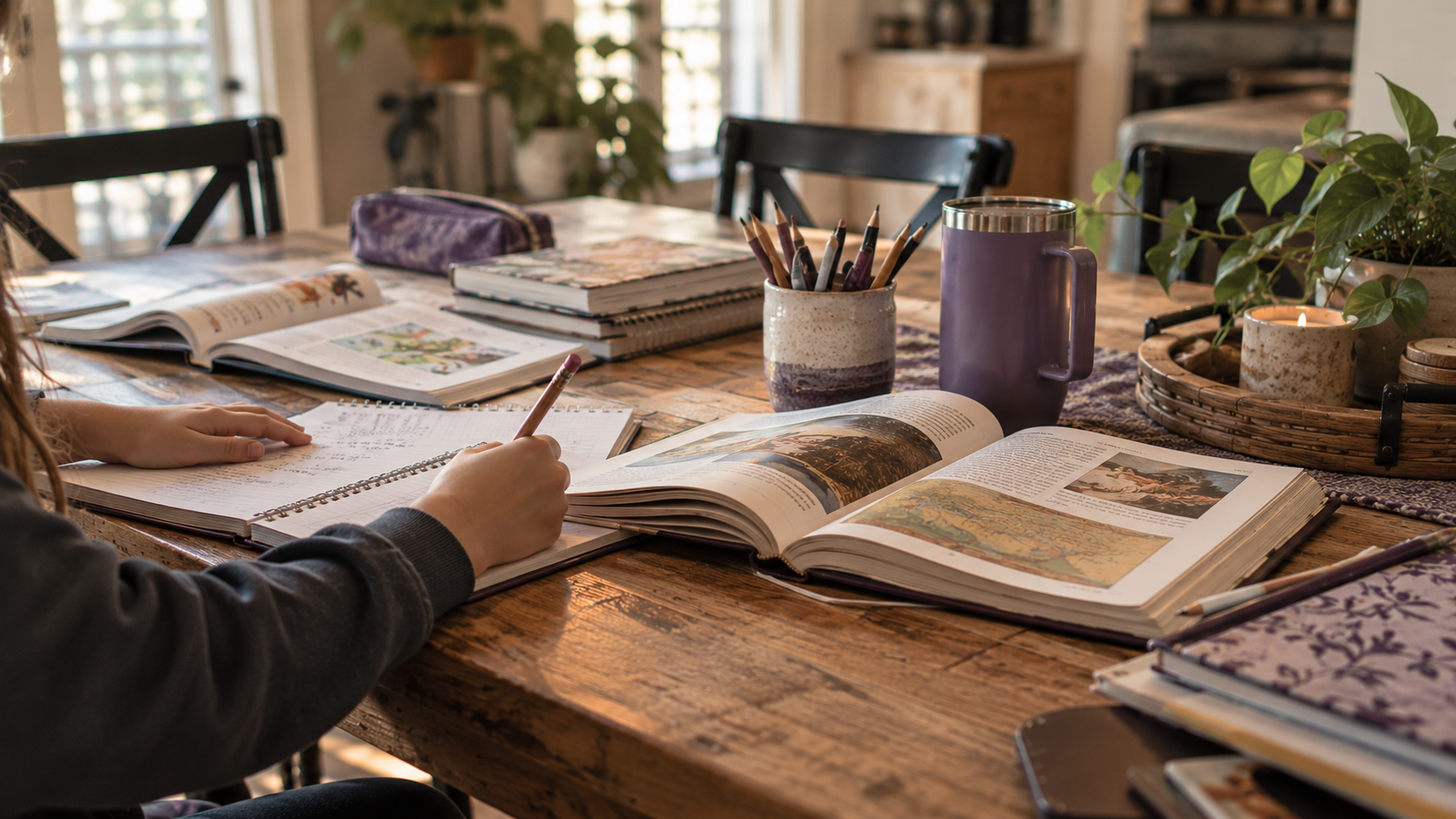
I think most of us begin homeschooling with some kind of picture in our heads. Even if we don't have a perfectly organized plan or a Pinterest board full of inspiration, we have ideas about what our days might look like. Maybe we imagine slow mornings with books spread across the kitchen table, children eagerly exploring their interests, and enough flexibility to make room for whatever catches our attention. Or maybe our vision is a little more structured, with carefully chosen curriculum, predictable routines, and the satisfaction of watching everyone make steady progress.
Whatever that picture looks like, it's usually built around the things we value. We want time together. We want our children to enjoy learning. We want the freedom to approach education in ways that make sense for our families. And somewhere in the middle of all those good intentions, we start imagining what a successful homeschool day should look and feel like.
Then we actually start living it.
The mornings aren't always slow. Sometimes the curriculum we were so excited about doesn't work the way we expected. One child needs more help than we anticipated, another finishes everything before we're ready, and someone is inevitably hungry just as we finally settle into a good rhythm. There are appointments, household responsibilities, difficult attitudes, unexpected interruptions, and days when everyone seems to need something different at exactly the same time.
And occasionally, there's a quiet realization that homeschooling doesn't look much like the picture we had in mind.
I don't think there's anything wrong with having expectations. In fact, I think it's important to know what we're working toward and why. A vision gives us direction. It helps us make decisions about curriculum, schedules, activities, and how we spend our time. The trouble comes when we begin treating that original picture as the standard against which every ordinary day must be measured.
Because a picture can only capture so much.
It can't show us how our children will change, what challenges we'll encounter, or which parts of homeschooling will turn out to matter most to our particular family. It doesn't account for the child who needs a little more time, the season when outside commitments become overwhelming, or the unexpected interest that ends up reshaping an entire afternoon. And it certainly doesn't prepare us for the reality that something can be good, valuable, and worth continuing even when it looks nothing like we imagined.
Sometimes the disconnect is small. We thought we'd spend more time outdoors, but our days have become a little too full. We imagined reading aloud every afternoon, but it keeps getting pushed aside. We pictured a beautiful, organized learning space, and instead we're working around laundry on the dining room table.
Other times, the difference is harder to dismiss. Maybe homeschooling feels more demanding than expected. Maybe the children aren't enjoying every subject, despite all the thought that went into choosing their materials. Maybe the flexibility that sounded so appealing has turned out to require more planning and intentionality than anyone warned us about.
Those experiences deserve more than a cheerful reminder to lower our expectations. Sometimes they reveal something that genuinely needs attention. A schedule might be too crowded. A particular approach might not be meeting a child's needs. We might need more support, clearer boundaries, or a different way of organizing our days. Not every frustration is simply part of the process, and we shouldn't feel obligated to accept things that aren't working.
But there's also value in recognizing when the problem isn't our homeschool itself. Sometimes the problem is that we're comparing our real, complicated, evolving family life to an image that was never capable of holding all of it.
And that's a different kind of problem to solve.
It's easy to become so attached to what we thought homeschooling would look like that we overlook what it's actually giving us. We may not have the peaceful mornings we imagined, but perhaps our children have time to ask questions without being rushed. We may not complete every beautiful project we saved, but perhaps we're learning how to work through challenges together. We may not follow the schedule exactly as written, but perhaps we've created enough flexibility to respond when someone needs something different.
None of those things automatically makes every difficult day worthwhile. And they don't mean we should stop trying to improve the parts of our homeschool that need improvement. They simply remind us that the value of what we're building can't always be measured by how closely it resembles our original expectations.
I think that's an important distinction, especially in a world where we're constantly seeing carefully selected glimpses of other people's homeschool lives. We see the finished projects, the beautifully arranged books, the field trips, and the children happily working together. Those moments can be real and wonderful. They can also be a very small part of a much bigger story.
The same is true of our own homes. A photograph of a lovely morning doesn't tell the whole story of that day, and a difficult afternoon doesn't tell the whole story of our homeschool. Both can exist within the same experience. Neither needs to become the defining measure of whether we're doing this well.
Maybe the better question isn't whether our homeschool looks the way we imagined it would. Maybe it's whether the life we're actually living reflects the reasons we chose this path in the first place.
Are our children receiving the education and support they need? Are we making room for the relationships and experiences we value? Are we willing to recognize when something needs to change, even if that means letting go of an idea we once loved?
Those questions won't produce a perfectly tidy picture. They might even lead different families to very different answers. But they give us something more useful than an idealized image to work toward.
They give us a way to evaluate the homeschool we actually have.
And perhaps that's where some of the freedom of homeschooling is found. Not in creating a life that always matches the picture we started with, but in having the opportunity to shape that life as we learn more about our children, our families, and ourselves.
The picture in our heads might have been what encouraged us to begin.
It doesn't have to be what determines whether we're succeeding.