“Let's Plan When”: Why Our Homeschool Doesn't Negotiate Every Day
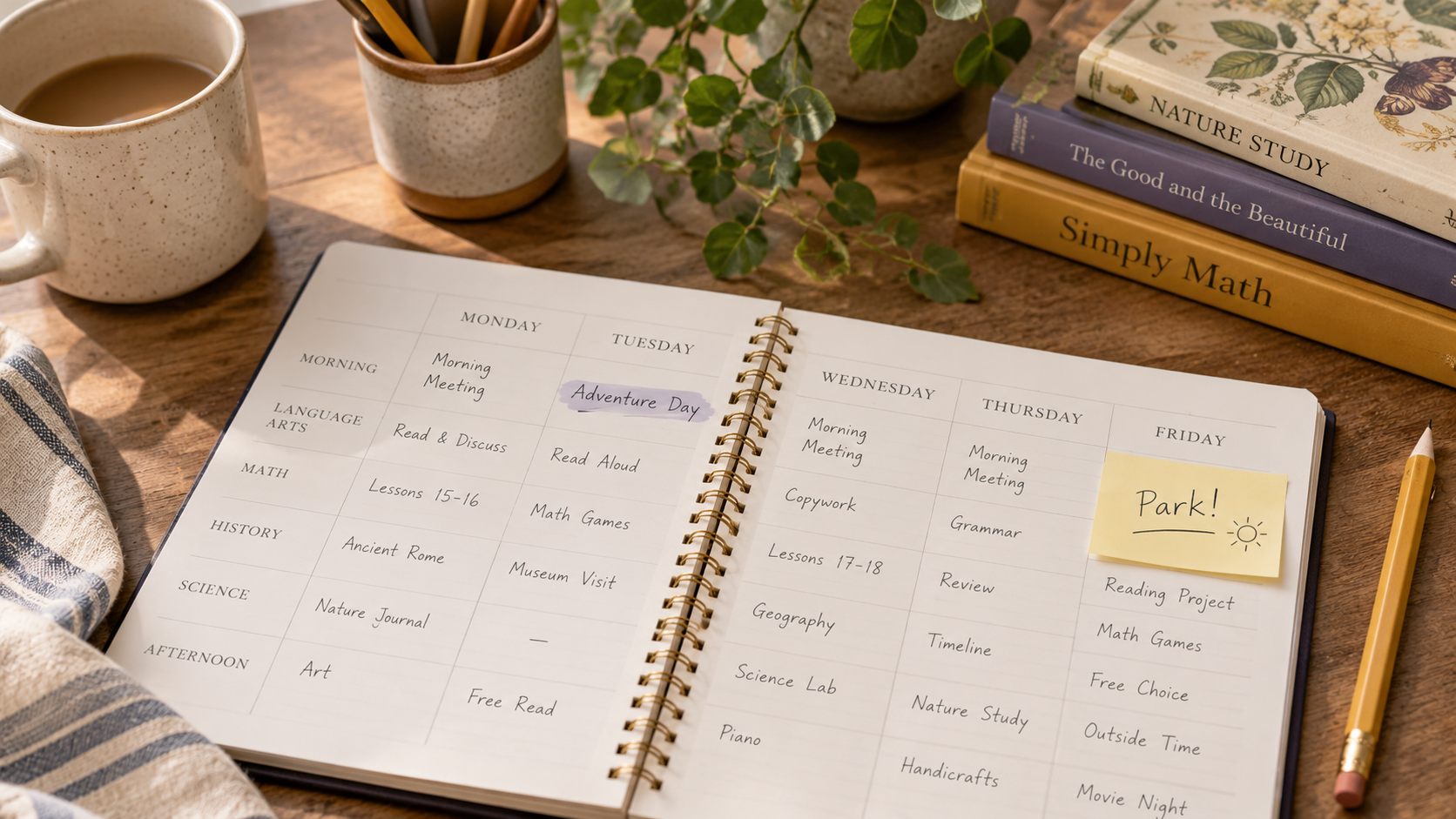
“Can we go to the park?”
“Let's plan when.”
That's a pretty typical conversation in our house. And depending on how you approach homeschooling, that response might sound a little less flexible than you'd expect from a family that chose to homeschool in part because we wanted more control over our time.
But I've learned that my kids do their best when they know what to expect. They like knowing how our days work, what's expected of them, and what comes next. They like having plans to look forward to, and they do better when those plans aren't constantly changing. And frankly, I do too. Homeschooling three children takes enough thinking and coordinating without every new idea turning into another decision we have to make before lunch.
I think sometimes we talk about homeschool flexibility as though it means being available to change the plan at any moment. We can go to the park on a Tuesday! We can decide to spend the afternoon at the museum! We don't have to ask anyone's permission to take a day off! And all of that is true. Those are things I genuinely love about homeschooling, and we take advantage of them. But having the freedom to make those choices doesn't mean I want to spend every day making them over and over again.
In our house, we've found that negotiation tends to invite more negotiation. If asking to go to the park means we might abandon math, then asking becomes worth trying. And if it works once, why wouldn't they try again tomorrow? Or ask whether we can finish early, move something to another day, or skip the part they don't particularly enjoy? Before long, the conversation isn't really about going to the park anymore. It's about whether today's expectations are still expectations.
And then, inevitably, there's frustration when the answer is no.
I don't think there's anything wrong with children asking questions or having opinions about how they spend their time. I want mine to have both. But I also don't think every request needs to become a negotiation, especially when the answer depends on things they may not be considering. We have three children with different responsibilities, interests, and schedules. There are appointments, activities, commitments, and ordinary household needs to account for. Sometimes what sounds like a simple change to one child would require rearranging the afternoon for everyone.
So instead of treating every good idea as a decision we need to make immediately, we've gotten into the habit of planning for it.
If someone wants to go to the park, we can look at when that would work. If they're excited about an activity, we can find a place for it in our week. Sometimes I'll tell them on Monday that Friday is going to be an at-home fun day. Sometimes Tuesday is already set aside for an adventure. They know those things are coming, and they can enjoy looking forward to them without wondering whether they need to convince me to make them happen.
And I think that's an important distinction. “Let's plan when” isn't a polite way of saying no. I mean it. Their ideas matter, and I'm willing to make room for them. I'm just not necessarily willing to rearrange the day we're already having.
There's a kind of freedom in that predictability that I didn't fully appreciate when my kids were younger. When everyone generally knows what happens next, we spend less time debating the schedule and more time actually doing the things we've planned. They don't have to test whether today's answer will be different from yesterday's, and I don't have to make a fresh decision every time someone thinks of something fun. We can get through our responsibilities, enjoy each other's company, and look forward to the things we've decided to do together.
Of course, we still change plans. Sometimes the weather is too beautiful to ignore. Sometimes someone needs a slower morning, an appointment runs long, or an opportunity comes along that makes more sense than whatever was on the schedule. I'm not interested in preserving a routine just for the satisfaction of following it. The routine is supposed to serve our family, not the other way around.
But I want those changes to be intentional rather than the result of whoever happened to ask most recently or most persistently. There's a difference between deciding together that today calls for something different and spending the whole morning negotiating whether we're going to do what we already agreed to do.
I also think this is one of the reasons I'm so particular about planning our homeschool. It isn't because I believe every hour needs to be accounted for or that a good education requires a perfectly organized schedule. It's because I've watched my own children, and I know they are at their best when our days have a rhythm. They work better together. They understand their responsibilities. They're less frustrated by ordinary boundaries because those boundaries aren't surprising.
And when we do something different, they get to enjoy it as something we're doing, rather than something they had to convince me to allow.
I know plenty of homeschool families who thrive with a much looser approach, and I think that's wonderful. One of the things I appreciate about homeschooling is that we don't all have to organize our families the same way. But I've stopped feeling like I need to make our days more spontaneous simply because spontaneity is one of the freedoms homeschooling offers.
We chose homeschooling because we wanted to be intentional about our children's education and our family's time. For us, that includes protecting the routines that help our days go well, making room for the experiences we want to have, and teaching our kids that wanting to do something doesn't always mean we need to do it right now.
So when one of my kids asks if we can go to the park, I'm probably still going to say, “Let's plan when.”
And then we're going to put it on the calendar.